


Page Summary:
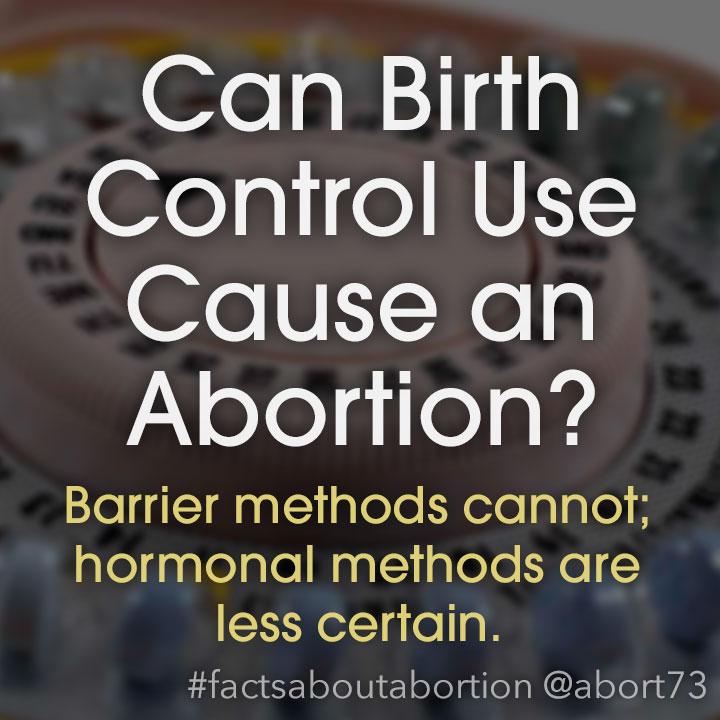
Some birth control methods provide a physical barrier to conception without altering a woman's hormones. Others rely on hormones to prevent ovulation and restrict implantation—at least in theory. Whether or not hormonal birth control can cause an abortion is the subject of much debate.
Before getting into the debate itself, here is a list of birth control methods that don't cause abortion, followed by a list of birth control methods that might cause abortion. Among physicians who oppose abortion, there is no consensus with regard to the abortive potential of hormone-based birth control methods. The point of contention centers on whether or not the thinning of the uterine lining is sufficient to impede implantation. The American Association of Pro-Life Obstetricians and Gynecologists has published two different position papers on this subject. Some members believe that birth control pills can be abortifacient; others believes that, although the condition of the uterus is altered, it does not interfere with implantation.
BIRTH CONTROL METHODS THAT DON'T CAUSE ABORTION1
- Continuous Abstinence - The only method that is 100% effective at preventing pregnancy and disease.
- Surgical Sterilization (Tubal Ligation or Vasectomy) - Permanent surgical methods of birth control. Tubal ligations prevent a woman's eggs from reaching her uterus. Vasectomies prevent sperm from entering a woman during intercourse. The estimated failure rate is less than 1%.
- The Male Condom - Prevents sperm from reaching the egg. The estimated failure rate is 11-16%.
- Diaphragm - A shallow latex cup that prevents sperm from reaching the egg, requires a visit with your health care provider for proper fitting. The estimated failure rate is 15%.
- The Female Condom - Worn by the woman, prevents sperm from reaching the egg. The estimated failure rate is 20%.
- Cervical Cap - A thimble-shaped latex cup that prevents sperm from reaching the egg. The estimated failure rate is 14-29%.2
- Periodic Abstinence or Fertility Awareness Methods - Being abstinent on the days you may be fertile or using a "barrier" method of birth control (condoms, diaphragms, or cervical caps) on fertile days. Though the US Department of Health and Human Services lists a relatively high failure rate (25%), other scientific bodies indicate that when used correctly, the failure rate can be less than 1%.3 Because fertility awareness requires more time and engagement than other methods, "perfect use" is harder to achieve.
BIRTH CONTROL METHODS THAT MIGHT CAUSE ABORTION1
- Intrauterine Device (IUD) - A small device shaped in the form of a "T" that is placed inside the uterus by a health care provider. It works to prevent fertilization by keeping sperm from entering the fallopian tubes and thins the lining of the uterus, which may prevent implantation if fertilization does occur. The estimated failure rate is less than 1%.
- Depo-Provera - Hormones delivered through injections, or shots, in the buttocks or arm every three months. It prevents ovulation, thickens the mucus lining so as to prevent fertilization, and thins the lining of the uterus, which may prevent implantation if fertilization does occur. The estimated failure rate is less than 1%.
- Oral Contraceptives (Birth Control Pills) - Delivers hormones orally through a daily pill that prevents ovulation, thickens the mucus lining so as to prevent fertilization, and thins the lining of the uterus, which may prevent implantation if fertilization does occur. The estimated failure rate is 5%.
- The Patch (Ortho Evra) - Hormones delivered through a skin patch worn on the lower abdomen, buttocks, or upper body. It prevents ovulation, thickens the mucus lining so as to prevent fertilization, and thins the lining of the uterus, which may prevent implantation if fertilization does occur. The estimated failure rate is 5%.
- The Hormonal Vaginal Contraceptive Ring (NuvaRing) - Hormones delivered through a ring that is inserted into the vagina for three weeks at a time. It prevents ovulation, thickens the mucus lining so as to prevent fertilization, and thins the lining of the uterus, which may prevent implantation if fertilization does occur. The estimated failure rate is 5%.
- Emergency Contraception ("Morning After" Pill, Postcoital Contraception, Plan B, etc.) - Delivers hormones orally through a high-dosage pill that prevents ovulation, thickens the mucus lining so as to prevent fertilization, and thins the lining of the uterus, which may prevent implantation if fertilization does occur. The estimated failure rate is 1%.
Within the broader medical community, the abortive potential of hormone-based birth control methods has been further clouded by a decades-old effort to redefine the beginning of pregnancy. In 1965, The American College of Obstetricians and Gynecologists (ACOG) issued a bulletin to redefine the term "conception." That bulletin stated that conception should be understood to mean "the implantation of a fertilized ovum."4 Why this change? The timing of their decision makes it almost certain that it was politically rather than scientifically motivated. The FDA had recently approved the sale of hormonal birth control pills, but "the pill" didn't fit the traditional definition of "contraceptive." Why? Because it doesn't just prevent conception; it also inhibits implantation—or at least purports to. If breakthrough ovulation and fertilization occurs (which is the biological beginning of individual human life), the embryo may find it difficult to implant because of changes the pill makes to the endometrium. This created an ethical problem for doctors who wanted to assure their patients that the pill was a contraceptive and not an abortifacient. Margaret Sanger, America’s foremost birth-control pioneer, had declared decades earlier that anything which interfered with pregnancy after fertilization was not birth control. It was abortion. These remarks come from a statement she released in 1932:
Some ill-informed persons have the notion that when we speak of birth control we include abortion as a method. We certainly do not. Abortion destroys the already fertilized ovum or the embryo; contraception, as I have carefully explained, prevents the fertilizing of the ovum by keeping the male cells away. Thus it prevents the beginning of life.5
Two years later, Sanger would testify to the following before the House Judiciary Committee:
As far as conception is concerned, in the method we advocate, by the use of the contraceptive, the ovum is not fertilized... We do not believe in interfering after conception has taken place. We do not believe in destroying after conception, but preventing conception... Birth-control means the control of the birth rate, by means that prevent conception. It does not mean that it interferes with the development of life; it does not mean that it interrupts the process of life nor that it takes life.6
To deal with their morally-awkward dilemma, ACOG simply changed the definition of "conception." By saying "conception," but meaning "implantation," it became possible to market hormonal birth control pills as contraceptives—as something that prevents "conception." By this point, Margaret Sanger was in the last year of her life and had already succumbed to the crippling effects of dementia. Planned Parenthood proved all too willing to abandon the narrowly-scientific definition of pregnancy espoused by its founder in favor of one that gave them more moral leeway.
If you look through the ACOG website today, you won't find a glossary of terms, but you will find numerous references to their altered definition of pregnancy and conception. In a pregnancy FAQ, they state that "fertilization, the union of an egg and a sperm, is the first step in a complex series of events that leads to pregnancy" (emphasis added).7 In the "Contraception" section of their Tool Kit for Teen Care, ACOG states that the IUD "can stop pregnancy" by "thin[ning] the lining of the uterus making it harder for a fertilized egg to attach."8 In their "Birth Control Pills FAQ," they state that one way the pill can "prevent pregnancy" is by making the uterus lining thin, "making it less likely that a fertilized egg can attach to it."9 By redefining the recognized beginning of pregnancy, birth control methods that would have otherwise been said to end pregnancy, can now be said to prevent pregnancy. These semantic changes do nothing to alter the biology of prenatal development, but they do plenty to confuse the ethical implications. In a 2005 Guttmacher Report on Public Policy, Rachel Benson Gold argued that "according to both the scientific community and long-standing federal policy, a woman is considered pregnant only when a fertilized egg has implanted in the wall of her uterus."10She goes on to say that though conception is "often used synonymously with fertilization… medically, (it) is equated with implantation." This is clearly an overstatement.
In The Developing Human: Clinically Oriented Embryology, which is a standard teaching text on prenatal development, the authors note that obstetricians date pregnancies in one of two ways—either "beginning from the first day of the last normal menstrual period (LNMP)," or "at fertilization or conception, about two weeks after LNMP."11 Note the interchangeable use of fertilization and conception, which is repeated again in a summary bullet on the same page. No mention is made of anyone aging an embryo from the time of implantation. In the index of Human Embryology & Teratology, the entry for "conception" takes you to a page describing the process of fertilization.12 Nothing is said about implantation. On the next page, it says that, "just as postnatal age begins at birth, prenatal age begins at fertilization." Alexander Tsiaras, who served as the Chief of Scientific Visualizatiion in Yale University's Department of Medicine, did a TED lecture in 2010 which included a sample of the video he created called, From Conception to Birth.13 Not surprisingly, the animated sequence begins with fertilization, not implantation. Finally, Merriam-Webster,14 MedicineNet,15 American Heritage,16 MediLexicon,17 Dictionary.com18 and WebMD19 all define conception as the union of sperm and egg. Only Webster's recognizes an alternate usage that relates to implantation. Four of the definitions explicitly identify "conception" as the onset of pregnancy.
The Guttmacher report is only able to point to one recognized medical body that makes conception synonymous with implantation and that is ACOG. No mention is made of the Journal of Maternal-Fetal Medicine study which found that 73% of participating OB/GYN's stated that conception is synonymous with fertilization.20 According to that same study, 50% of the OB/GYN's surveyed indicated that pregnancy begins at fertilization. Forty-eight percent indicated it begins at implantation. The study concluded: "Neither ACOG definition has been consistently adopted by its members whose definitions are more consistent with lay and embryologist definitions…. The ACOG is urged to reconsider its definitions." Quoting ACOG, in a text box titled "When is a Woman Pregnant?," the Guttmacher report states that "if fertilization does occur, the zygote divides and differentiates into a 'preembryo' while being carried down the fallopian tube toward the uterus."21 Why do they put "preembryo" in quotations? Because it's not a scientifically-valid term. Human Embryology & Teratology offers this rebuttal:
The term "pre-embryo" is not used [in this textbook] for the following reasons: (1) it is ill-defined because it is said to end with the appearance of the primitive streak or to include neurulation; (2) it is inaccurate because purely embryonic cells can already be distinguished after a few days, as can also the embryonic (not pre-embryonic!) disc; (3) it is unjustified because the accepted meaning of the word embryo includes all of the first 8 weeks; (4) it is equivocal because it may convey the erroneous idea that a new human organism is formed at only some considerable time after fertilization; and (5) it was introduced in 1986 "largely for public policy reasons."22
Reason number five is particularly telling—indicating again that ACOG's decision to redefine pregnancy was primarily a political one. Though obstetricians have largely ignored ACOG's revisionist definitions, government employees have been more willing to buy in—at least in part. In the 1975 version of the Federal Register, in a section titled, "Protection of Human Subjects," the Department of Health, Education, and Welfare (now HHS) declared that, "'Pregnancy' encompasses the period of time from confirmation of implantation until expulsion or extraction of the fetus."23 They further declared that, “'Fetus' means the product of conception from the time of implantation until a determination is made, following expulsion or extraction of the fetus, that it is viable." The "Protection of Human Subjects" amendment was first added to the Federal Register in 1973,24 to ensure that no human subjects would be used for medical testing without giving their full, informed consent. The 1974 version proposed adding language to specifically address fetuses.25 The 1975 version was the first to define "pregnancy" and "fetus."
It is worth noting that according to the 1977 version of the Federal Register, the reason HHS federally defined pregnancy as beginning at implantation was because, "No medical tests exist which can confirm conception."26 They call their definition "a matter of practical medical and regulatory necessity," and notice they use the word "conception" as though it were synonymous with "fertilization." Even though it is no longer true that pregnancy can't be detected until implantation, the definitions established in 1975 have been left unchanged.27 A Third Way memo points to these definitions as "proof" that emergency contraception is in fact, contraceptive and not abortive.28 But those who claim a "long-standing federal policy" of defining pregnancy to begin at implantation are missing a significant fact. As indicated by the 1977 preamble, these provisions were not made with emergency contraception in mind. Contraception isn't even mentioned. The issue was the role pregnancy plays on informed consent. Certain medical tests might be fine for a woman who is not pregnant, but dangerous for the offspring of one who is. The emergence of in vitro fertilization presented other definitional challenges. When does a woman whose ovum is fertilized artificially actually become pregnant? HHS decided to define pregnancy as beginning at implantation, arguing that this was a "practical necessity" since implantation is the earliest point at which pregnancy can be verified. But if that's really the case, definitions based on a practical-ignorance of fertilization should not be applicable to things like embryonic stem cell research or in vitro fertilization, where it is medically known that fertilization has occurred. Nor is it appropriate to argue that since we couldn't test for pregnancy before implantation in 1977, we shouldn't have any ethical concerns about birth control methods that impede implantation today.
Outside the Federal Register's guidelines for protecting human subjects, the closest we got to a federal definition of pregnancy was a 2008 draft of President George W. Bush's "Provider Conscience Rules." It stated that conscientious objectors to abortion could opt out of "any of the various procedures -- including the prescription, dispensing and administration of any drug or the performance of any procedure or any other action -- that results in the termination of life of a human being in utero between conception and natural birth, whether before or after implantation."29 Had that language remained, it would have essentially defined fertilization as the beginning of pregnancy. In the version that actually became law, the specifics of what could constitute an abortion were left undefined, but The Washington Post noted that "both supporters and critics said the regulation remains broad enough to protect pharmacists, doctors, nurses and others from providing birth control pills, Plan B emergency contraception and other forms of contraception."30
Upon taking office, NPR reported that President Obama planned to immediately rescind the newly passed "Provider Conscience Rules,"31 but public opinion delayed him by almost two years and resulted in a limiting of the Bush legislation instead of a full reversal.32 In the current language of the conscience protection rule, you will read the following:
The 2008 Final Rule did not provide that the term ‘‘abortion,’’ as contained in the Federal health care provider conscience protection statutes, includes contraception. However, the comments reflect that the 2008 Final Rule caused significant confusion as to whether abortion also includes contraception. The provision of contraceptive services has never been defined as abortion in federal statute. There is no indication that the federal health care provider conscience statutes intended that the term ‘‘abortion’’ included contraception.33
Though this explicitly declares that medical providers cannot conscientiously refuse to distribute contraceptives, it makes no reference to contraceptives that have the potential to cause an abortion. And the only way to conclusively say that the birth control pills or IUDs are contraceptive and not abortafacient is to define pregnancy as beginning at implantation instead of fertilization. For their part, Planned Parenthood is happy to accept this modified definition of pregnancy and states on their website that "Pregnancy begins during implantation when the hormone needed to support pregnancy is released."34 Planned Parenthood, of course, sees nothing wrong with abortion. They're perfectly willing to destroy human embryos and fetuses at any stage of pregnancy. For those who do have an ethical problem with abortion, the birth control debate becomes much more complex. Does the birth control pill cause abortion? For the most part, it all depends on when you think pregnancy begins. But anyone who wants to make an ethical distinction between emergency contraception and regular birth control pills would do well to consider one more statement from Rachel Benson Gold's Guttmacher report. She writes that anyone in favor of "enforcing a definition that pregnancy begins at fertilization" must realize that such a definition "would implicate not just some hormonal methods, but all of them."35
This page was last updated on April 26, 2018. To cite this page in a research paper, visit: "Citing Abort73 as a Source."
- Unless otherwise noted, reported failure rates come from the Department of Health & Human Services.“Birth Control Methods,” http://www.womenshealth.gov/publications/our-publications/fact-sheet/birth-control-methods.pdf (Nov 21, 2011).
- Planned Parenthood. “Cervical Cap (FemCap),” http://www.plannedparenthood.org/health-topics/birth-control/cervical-cap-20487.htm (2011).
- ScienceDaily. “Natural Family Planning Method As Effective As Contraceptive Pill, New Research Finds,” http://www.sciencedaily.com/releases/2007/02/070221065200.htm (Feb 21, 2007).
- American College of Obstetricians and Gynecologists Terminology Bulletin. Terms Used in Reference to the Fetus. No. 1. Philadelphia: Davis, September, 1965.
- Margaret Sanger, 1932 statement regarding “The Pope’s Position on Birth Control,” The Selected Papers of Margaret Sanger, Volume 2, Ed. Esther Katz (2006), 257-258.
- Margaret Sanger, 1934 Testimony to House Judiciary Committee, The Selected Papers of Margaret Sanger, Volume 2, Ed. Esther Katz (2006), 257-258.
- American College of Obstetricians and Gynecologists. FAQ156, PREGNANCY. “How does pregnancy begin?” http://www.acog.org/~/media/For%20Patients/faq156.ashx (2011).
- American College of Obstetricians and Gynecologists. Fact Sheet; Tool Kit for Teen Care, 2nd. Ed. “Contraception.” http://www.acog.org/~/media/Departments/Adolescent%20Health%20Care/Teen%20Care%20Tool%20Kit/Contraception.ashx (2010).
- American College of Obstetricians and Gynecologists. FAQ021, CONTRACEPTION. “How does pregnancy begin?” “Contraception”:http://www.acog.org/~/media/For%20Patients/faq021.ashx (2011)
- Rachel Benson Gold. “The Implications of Defining When a Woman Is Pregnant” The Guttmacher Report on Public Policy (May 2005, Volume 8, Number 2). http://www.guttmacher.org/pubs/tgr/08/2/gr080207.html
- Keith L. Moore, The Developing Human: Clinically Oriented Embryology, 7th edition. (Philadelphia, PA: Saunders, 2003), 90.
- Ronan O’Rahilly & Fabiola Muller, Human Embryology & Teratology, 3rd edition. (New York: John Wiley & Sons, Inc, 2001), 87, 495.
- Alexander Tsiaras: “Conception to birth—visualized,” TED Partner Series(Dec 2010) http://www.ted.com/talks/alexander_tsiaras_conception_to_birth_visualized.html
- Conception: 1. The process of becoming pregnant involving fertilization or implantation or both (Merriam-Webster, Incorporated, 2011) http://www.merriam-webster.com/medlineplus/conception
- Conception: 1. The union of the sperm and the ovum. Synonymous with fertilization. 2. The onset of pregnancy, marked by implantation of the blastocyst into the endometrium. (MedicineNet, Inc., 1996-2011) http://www.medterms.com/script/main/art.asp?articlekey=31242
- Conception: 1. Formation of a viable zygote by the union of the male sperm and female ovum; fertilization. (The American Heritage® Dictionary of the English Language, Fourth Edition, 2000, 2009) http://www.thefreedictionary.com/conception
- Conception: 2. Fertilization of oocyte by a sperm. (Stedman’s Medical Dictionary, 2006) http://www.medilexicon.com/medicaldictionary.php?t=19609
- Conception: 2. fertilization; inception of pregnancy. (Dictionary.com Unabridged Based on the Random House Dictionary, 2011) http://dictionary.reference.com/browse/conception
- Pregnancy and Conception: Most doctors calculate the start of pregnancy from the first day of your last menstrual period. This is called the “menstrual age” and is about two weeks ahead of when conception actually occurs. (WebMD, LLC, 2005-2011) http://www.webmd.com/baby/guide/understanding-conception
- Joseph A. Spinnato MD. “Informed consent and the redefining of conception: A decision illconceived?” The Journal of Maternal-Fetal Medicine (Volume 7, Issue 6, pages 264–268, November/December 1998) Abstract.
- Rachel Benson Gold. “The Implications of Defining When a Woman Is Pregnant” The Guttmacher Report on Public Policy (May 2005, Volume 8, Number 2). http://www.guttmacher.org/pubs/tgr/08/2/gr080207.html
- Ronan O’Rahilly & Fabiola Muller, Human Embryology & Teratology, 3rd edition. (New York: John Wiley & Sons, Inc, 2001), 88.
- Department of Health, Education, and Welfare, Federal Register, “Protection of Human Subjects,” http://archive.hhs.gov/ohrp/documents/19750808.pdf (January 13, 1975), 33529.
- Department of Health, Education, and Welfare, Federal Register, “Protection of Human Subjects,” http://archive.hhs.gov/ohrp/documents/19731009.pdf (October 9, 1973), 27882.
- Department of Health, Education, and Welfare, Federal Register, “Protection of Human Subjects,” http://archive.hhs.gov/ohrp/documents/19731009.pdf (May 30, 1974), 13914.
- Department of Health, Education, and Welfare, Federal Register, “Protection of Human Subjects,” http://archive.hhs.gov/ohrp/documents/19770113.pdf (January 13, 1977), 2792.
- Department of Health & Human Services, Code of Federal Regulations, “Protection of Human Subjects,” http://archive.hhs.gov/ohrp/humansubjects/guidance/45cfr46.html (July 14, 2009), §46.202.
- Rachel Laser, “Emergency Contraception: Contraceptive, not Abortifacient” The Third Way Name Project, “Protection of Human Subjects,” http://content.thirdway.org/publications/43/Third_Way_Memo_-_Emergency_Contraception_-_A_Fact_Sheet_-_EC_is_Contraceptive_not_Abortifacient.pdf (accessed Dec 13, 2011).
- Rob Stein, “Workers’ Religious Freedom vs. Patients’ Rights,” The Washington Post. http://www.washingtonpost.com/wp-dyn/content/article/2008/07/30/AR2008073003238.html?sid=ST2008082103218 (July 31, 2008).
- Rob Stein, “Protections Set for Antiabortion Health Workers,” The Washington Post. http://www.washingtonpost.com/wp-dyn/content/story/2008/08/21/ST2008082103218.html (Aug 22, 2008).
- Rob Stein, Deirdre McQuade, & Nancy Northup, “Obama To Rescind Provider Conscience Regulation,” Talk of the Nation. http://www.npr.org/templates/story/story.php?storyId=101349857 (Mar 2, 2009).
- Chuck Donovan, “Conscience Regulations: HHS Stops (Just) Short of Rescission,” The Foundry. http://blog.heritage.org/2011/02/18/conscience-regulations-hhs-stops-just-short-of-rescission/ (Feb 11, 2011).
- Department of Health & Human Services, Federal Register, “Rules and Regulations,” http://www.gpo.gov/fdsys/pkg/FR-2011-02-23/pdf/2011-3993.pdf (Feb 23, 2011), 9974.
- Planned Parenthood, “Am I Pregnant?,” http://www.plannedparenthood.org/info-for-teens/pregnancy/am-pregnant-33831.asp (2011).
- Rachel Benson Gold. “The Implications of Defining When a Woman Is Pregnant” The Guttmacher Report on Public Policy (May 2005, Volume 8, Number 2). http://www.guttmacher.org/pubs/tgr/08/2/gr080207.html
Footnotes
Parent Page:
- Birth Control and Abortion: Be wary when you hear the abortion industry suggesting ways to reduce abortion.
For Further Study:
- What Birth Control Can & Cannot Do (Abort73 Blog)
- Where is the Utopian Future Margaret Sanger Promised Us? (Abort73 Blog)
- Was Planned Parenthood’s Founder Anti-Abortion? (Abort73 Blog)
- Does the Birth Control Pill Cause Abortions? (by Randy Alcorn)
- The Tangled Web of IVF and Birth Control (Abort73 Blog)
- Gandhi on Birth Control and Abortion (Abort73 Blog)
- Margaret Sanger and the Religion of Birth Control (Abort73 Blog)
- Birth Control and the Doctrine of Predestination (Abort73 Blog)